AI: Bill Gates Warns It Makes Nuclear Weapons Look Like Nothing
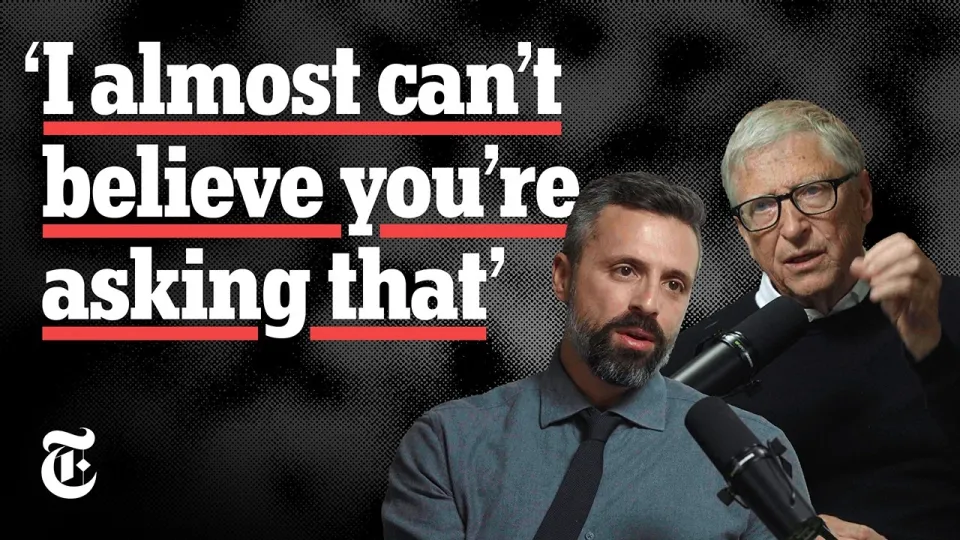
Video: Bill Gates: A.I. ‘Makes Nuclear Weapons Look Like Nothing’ | The Ezra Klein Show
Want articles like this for your own video to promote it on YouTube and Google? Order them through the Telegram bot @sat_sit_bot. Articles with your video embedded are written and posted by the bot itself — on popular topical sites (no ads). Your first 50 articles are free.
· based on the channel The Ezra Klein Show
Key takeaways
- Gates says AI is the most dangerous technology humanity has approached — more consequential than nuclear weapons.
- He calls the idea of AI companies self-regulating "insane" and demands government action before cyber and bio thresholds are crossed.
- Gates predicts catastrophic cyberattacks, bio-terrorism and mass job loss unless regulation arrives first.
- The Gates Foundation, set to spend down roughly $200 billion over two decades, now treats AI-driven inequality as a core priority.
- Gates also frames the AI race with China and job disruption as problems markets alone cannot solve.
Bill Gates argues that artificial intelligence is the most consequential and dangerous technology humanity has ever approached — a threat he ranks above nuclear weapons — and that letting the AI industry regulate itself is "insane." That is the central claim of his conversation with Ezra Klein, and the full transcript is available through The Ezra Klein Show episode page.
What Gates actually said about AI risk
Gates has moved from AI optimist to something closer to alarmist, and he says the alarm has not gone far enough. In the interview he describes a near future marked by catastrophic cyberattacks, bio-terrorism and mass job loss unless governments act. The line that anchors his argument is that AI "makes nuclear weapons look like nothing" — a comparison that reframes the debate from product safety to civilizational risk.
What makes the position notable is its source. Gates is not a critic on the outside of the tech industry; he is the co-founder of Microsoft, an early and major backer of OpenAI, and a technologist who spent decades arguing that computing would improve lives. His warning is therefore less a rejection of AI than a claim that the people building it, and the officials overseeing it, are in denial about the speed of what is coming.
Cyber and bio thresholds: the two dangers Gates names first
Gates points to two specific thresholds where AI capability turns into AI danger: offensive cyber and biological weapons. In both domains, the concern is not a hypothetical superintelligence but a concrete capability jump — models that can find and exploit software vulnerabilities faster than defenders can patch them, or that lower the expertise needed to design a harmful pathogen.
His framing has a practical consequence. If the risk arrives at identifiable capability thresholds, then regulation can be triggered by measurement rather than by waiting for a disaster. That is a different policy model from the current patchwork, where rules are written after harm is documented and often lag the technology by years.
Why Gates calls AI self-regulation "insane"
Gates is emphatic that industry self-regulation cannot work, and his reasoning is blunt: the incentives point the wrong way. Companies compete on capability and speed to market, and a firm that slows down unilaterally loses ground to rivals that do not. Asking them to police themselves, in his view, is asking them to act against their own competitive interest.
He illustrates the absurdity with a legal remedy: if an AI system caused mass casualties, a lawsuit afterward would be no answer. The exchange over litigation is one of the sharpest moments in the episode, and it captures the core of his argument — ex-post liability is not a substitute for ex-ante rules when the harm is irreversible.
The race with China and the safety trade-off
Gates treats the US–China AI competition as a real constraint on safety policy, not an excuse to abandon it. The race creates pressure to cut corners, because any slowdown by one side is read as an advantage for the other. His answer is not to pretend the competition does not exist but to design regulation that applies broadly enough that no single company or country gains by defecting.
This is the same logic that shaped nuclear arms control: rules work when they bind the major players at once. Gates' argument implies that the relevant unit of regulation is the industry and the international system, not the individual lab.
Jobs, inequality and a no-scarcity labor market
On employment, Gates describes disruption that is broad rather than confined to manual work. He discusses the idea of a no-scarcity job market, the question of taxing AI labor as a way to fund the transition, and the notion of "human reserved" jobs — roles deliberately kept for people. He also raises AI as a tool for preserving and teaching global languages, a rare optimistic thread in the conversation.
His sharper concern is distribution. The Gates Foundation, which is set to spend down around $200 billion over the next two decades, has made steering AI toward equality rather than inequality a new priority. Gates notes that developing nations face the economic shock without the fiscal capacity to cushion it, and that inequity persists partly because of distance — a remark that resonated with listeners thinking about inequality closer to home.
Regulation, children and education
Gates extends the argument to children and schools. He discusses learning loss in rich countries, the case for AI-specific protections for minors, and how AI could either widen or narrow educational gaps depending on who gets access. The policy question he keeps returning to is the same: the technology will diffuse regardless, so the choice is whether guardrails are set before or after the damage.
The questions listeners kept raising
Viewers of the episode reacted less to any single statistic than to Gates' demeanor — several noted they had never seen him so visibly agitated, and one summarized the dynamic as Klein saying things are bad while Gates replies that they are worse. That reaction produced a recurring set of questions worth addressing directly.
- Is Gates right that self-regulation fails? His argument rests on incentives, not character: competitive pressure punishes unilateral restraint, so voluntary standards erode exactly when capability races tighten.
- Is the nuclear comparison literal? It is a ranking of consequence and irreversibility, not a claim that AI detonates. The point is that the failure modes — cyber, bio, mass displacement — are hard to reverse once triggered.
- What about the race with China? Gates treats it as a reason for broad, coordinated rules rather than for unilateral speed, since defection is what makes narrow rules fail.
- What does the foundation's role change? With roughly $200 billion to deploy over two decades, the Gates Foundation can fund access and equity work at a scale that shapes how AI reaches developing countries.
Useful links
- Full transcript of the conversation: https://www.nytimes.com/2026/09/29/opinion/ezra-klein-podcast-bill-gates.html
- Book recommendations from guests of the show: https://www.nytimes.com/article/ezra-klein-show-book-recs.html
Bottom line
Gates' message is not that AI should be stopped but that it is being deployed faster than the institutions meant to govern it can respond, and that the gap is where the danger lives. His proposed remedy is unglamorous: binding rules, measurable thresholds for cyber and bio capability, and public investment to keep the benefits from pooling at the top. The interview is worth reading in full rather than in clips, because the force of the argument comes from Gates conceding the technology's upside while refusing to soften the risk. This analysis draws on the conversation published by The Ezra Klein Show, whose full transcript is linked above.
Source: Bill Gates: A.I. ‘Makes Nuclear Weapons Look Like Nothing’ | The Ezra Klein Show · Markdown version
Questions & answers
Why does Bill Gates compare AI to nuclear weapons?
Gates uses the comparison to rank consequence and irreversibility, not to suggest AI explodes. He argues that AI-enabled cyberattacks or bio-terrorism could cause harm on a scale that existing institutions cannot absorb or undo, which places the technology above nuclear weapons in his risk ranking.
Why does Gates think AI self-regulation is "insane"?
His reasoning is about incentives rather than intentions. Companies competing on capability and speed to market are punished for slowing down alone, so voluntary standards tend to erode precisely when the race intensifies. Gates argues that binding government rules are the only mechanism that survives that pressure.
What does Gates say about AI and jobs?
He describes disruption across a wide range of work, not just manual labor, and discusses ideas such as taxing AI labor, a no-scarcity job market, and roles deliberately reserved for humans. His deeper concern is distribution: gains could concentrate while displaced workers and developing economies absorb the costs.
What is the Gates Foundation doing about AI?
The foundation, set to spend down roughly $200 billion over two decades, has made steering AI toward equality a new priority. That includes work on access, education, global languages, and the economic impact on developing nations that lack the fiscal room to cushion rapid labor disruption.